
Approvals, delivery and fencing: what to check
A plain-English guide to the approvals and site questions that usually come up with granny flats, cabins, site offices, containers and fencing in Queensland, with notes for New Zealand buyers and overseas shipping container buyers.
General information only
Every site and council is different, and the rules change. This page is general information, not legal or building advice. Before you buy or place a building, or build a fence, check with your local council and a licensed building certifier. We’re happy to talk it through with you when you ask for a quote.
Information checked 18 October 2026. Sources are listed at the end of this page.
Granny flats in Queensland
In Queensland planning law, a granny flat is a secondary dwelling: a dwelling on the same lot that is used together with, and is smaller than (subordinate to), the main house. It can’t be developed on its own or separately titled. Two similar-sized homes on one lot are usually treated as a dual occupancy instead, which has different rules.
You can now rent a granny flat to anyone
Since 26 September 2022, Queensland’s planning rules no longer restrict who can live in a secondary dwelling. You can rent a granny flat to anyone, whether or not they are related to the people in the main house. This change applies in every council area in Queensland.
If an older approval for your granny flat has conditions limiting who can live in it, you may need to apply to council to change those conditions.
Approvals you’ll still need
- Building approval: every new granny flat needs building approval, and so does converting an existing structure into one. You can get it from your council or a private building certifier.
- Planning (development) approval: this depends on your council’s planning scheme, zone and site, for example flood mapping, setbacks and size. Check with your council before you order.
- Plumbing approval: usually needed for kitchens, bathrooms and connections to water and sewer or an on-site system.
- Renting it out: if a granny flat used by family becomes a rental, extra fire-safety and sound-insulation requirements of the building code can apply. A building certifier can advise. Tenancy agreements are covered by the Residential Tenancies Authority (RTA).
In Balonne Shire
Balonne Shire Council’s current planning scheme is the Balonne Shire Planning Scheme 2024, which commenced on 29 January 2024. Under it:
- A “dwelling house” includes one house plus a secondary dwelling (granny flat) on the same lot. In residential zones it is generally accepted development subject to requirements, which means it can proceed without a planning application if it meets the scheme’s requirements. Building approval is still needed.
- Flood hazard areas: building work for a house (Class 1a) on land mapped in the flood hazard overlay is code assessable, so a planning application is needed. Check council’s flood hazard maps for St George, Dirranbandi, Thallon, Bollon and Mungindi first.
- For dual occupancies and multiple dwellings (not granny flats), the scheme notes that dwellings that look like relocatable or temporary structures are “discouraged”, although strong architectural design isn’t ruled out. Talk to council early if that’s your plan.
Council also offers building certification and plumbing assessment. Contact Balonne Shire Council on (07) 4620 8888, by email at council@balonne.qld.gov.au, or at 118 Victoria Street, St George QLD 4487.
Cabins, site offices and containers
Whether a portable building needs approval depends on how it will be used (somewhere people live or sleep, an office, or storage only), how long it stays, how it’s fixed down and where it goes on the lot. Councils apply the rules differently, so always check yours.
- Shipping containers are treated like sheds (a Class 10a building) in Queensland when used for storage. Used as a granny flat or extension, they are assessed as habitable buildings.
- How long it stays matters, and councils differ. For example, Western Downs Regional Council says a container on your property for more than 30 days needs building approval. Toowoomba Regional Council says containers are generally assessable because of their size and need approval before they go on site, even for a short time.
- Footings and tie-down: councils commonly ask for a footing or slab design certified by a Registered Professional Engineer of Queensland (RPEQ) to anchor the building and carry its weight.
- Siting: buildings must meet boundary setback and siting rules (the Queensland Development Code), and must stay clear of council water, sewer and stormwater pipes. Ask council for your property’s drainage plan.
- Containers on site: councils may require roof drainage, a sealed base to stop vermin, a protective paint finish and, for safety, a window so no one can be locked in.
Before you order, contact your council’s planning team or a building certifier, tell them how you’ll use the building and where it will sit, and ask what approvals you need.
Small work that may not need building approval
Under Queensland’s Building Regulation 2021, some minor work is “accepted development” and doesn’t need a building approval. Examples include a fence no more than 2 m high (not a pool fence), a retaining wall up to 1 m with no load above it, and a small shed up to 10 m² (with height and side-length limits, and not in a tropical cyclone area). The owner must still make sure the work meets building standards and setbacks, and council planning rules may still apply. Most portable buildings are larger than these limits.
Getting your building to site
Most portable and modular buildings travel by truck. In Australia, a standard heavy vehicle and its load is generally limited to 2.5 m wide and 4.3 m high. Anything bigger is an oversize load that must travel under a government notice or permit, and may need pilot or escort vehicles depending on its size and route. Modular buildings are a recognised example of a “large indivisible item” for these rules. Your transport operator handles these requirements, but the size of your building affects the route, cost and timing.
In New Zealand, loads above standard dimension limits are “overdimension” and may need an NZ Transport Agency Waka Kotahi permit. House and building relocations are a common example.
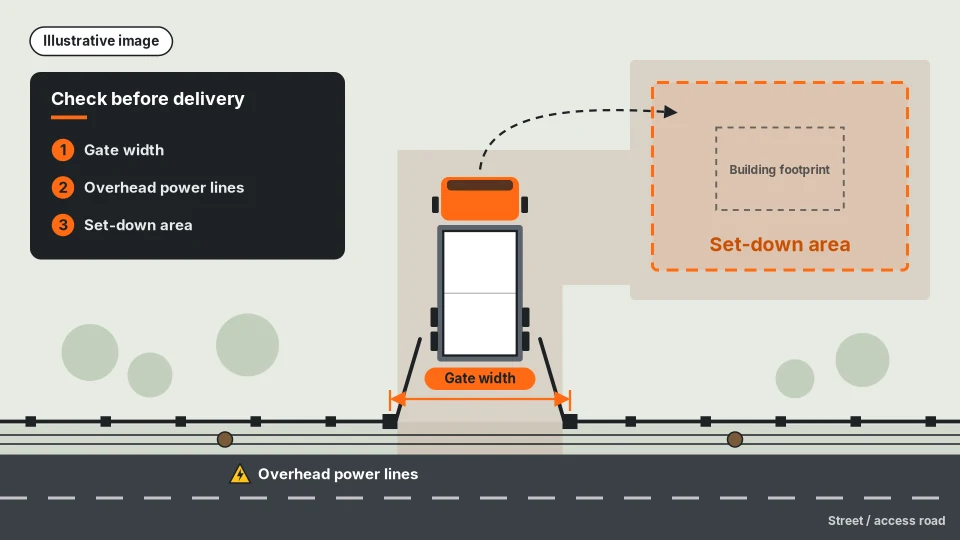
Help the delivery go smoothly
- Measure the gate and driveway width, and check for low branches, overhead power lines and tight turns.
- Make sure the set-down area is firm, level and dry, and that a truck (and crane, if needed) can reach it.
- Have your approvals in place and footings or piers ready before delivery day.
- Send us photos of the access and set-down area with your quote request.
We arrange delivery for you by tilt truck, crane truck or Hiab, depending on the unit and your site access. For New Zealand orders, how shipping is arranged varies by job and is confirmed on your quote. Outside Australia and New Zealand, we supply shipping containers only.
Buying for a New Zealand site
- Granny flats up to 70 m²: since 15 January 2026, some new single-storey, standalone dwellings up to 70 m² can be built without a building consent, if all the exemption conditions are met and licensed building professionals carry out or supervise the work. You must get a Project Information Memorandum (PIM) from council before work starts and notify council when it’s finished. Development contributions may apply. Some exemption conditions changed from 8 October 2026.
- Resource consent: a separate national standard (for detached minor residential units) may let you build without a resource consent if permitted-activity standards are met.
- Transport: loads over standard dimension limits may need an NZTA overdimension permit.
Ask your council whether these rules apply to a transportable or relocated building on your site before you order.
Buying a shipping container for a site outside Australia and New Zealand
We ship shipping containers worldwide. Our other buildings, toilets and change rooms, and fencing are supplied to Australia and New Zealand only. How overseas container shipping is arranged varies by job and is confirmed on your quote.
This guide doesn’t cover approvals, building rules, import requirements or customs outside Australia and New Zealand. Check with the authorities in your country before you order.
Fencing: standards and rules in plain terms
Do I need approval?
In Queensland, a fence up to 2 m high (that isn’t a pool fence) generally doesn’t need building approval. A fence over 2 m generally does. Council planning rules can still apply, for example on heritage or character properties, or under local laws about dangerous fencing.
Barbed wire, razor wire and electric fences
Rules on barbed wire, razor wire and electric fences are set by each council and vary a lot. For example, Logan City Council bans razor wire everywhere in its area and restricts barbed and electric fences near parks and in some zones. Electric security fences must be installed to the relevant Australian Standard (AS 3016). Check your council’s local laws before choosing a security topping.
Relevant Australian Standards
- AS 1725.1-2010: Chain link fabric fencing, Part 1: Security fences and gates. Sets minimum requirements for chain-link security fences and gates, including materials, coatings, posts, footings, gates, barbed-wire tops and installation. It covers rail-less and pipe-rail designs. It applies to chain-link fencing specifically.
- AS/NZS 1170.2:2021: Wind actions. The standard designers use to work out wind loads on structures in Australia and New Zealand. Wind load matters for tall or solid fences (and signs or shade cloth attached to them), so ask for footings and post spacing that suit your site’s wind exposure.
- AS 4687.2:2022: Temporary fencing. Covers the design, installation and performance of temporary construction fencing and pedestrian barriers.
AS 1725.1 applies to chain-link fencing. We don’t claim that a particular Australian Standard applies to welded-mesh or steel picket fencing. If your project specifies a standard, include it in your quote request.
Pool fences are different
A security or boundary fence isn’t automatically a compliant pool barrier. In Queensland, pool fences must meet the Queensland Development Code MP 3.4, which calls up AS 1926.1-2007. Requirements include a barrier at least 1200 mm high, a non-climbable zone, and gates that self-close and self-latch. Talk to a pool safety inspector or certifier.
Fences between neighbours
In Queensland, neighbours generally share the cost of a “sufficient” dividing fence equally. That’s usually a fence between 0.5 m and 1.8 m high made of common fencing materials such as chain wire or metal panels. If one neighbour wants a higher or more secure fence, they normally pay the difference. Give your neighbour a written notice to fence with at least one quote before work starts. Unresolved disputes can go to mediation or QCAT.
Installing your fence
D & B Solutions supplies fencing and gates only. We don’t install. You arrange installation yourself or with a contractor of your choice. Before work starts, check the approval rules with your council or a building certifier: in Queensland, a fence over 2 m high generally needs building approval, and pool barriers have their own rules (see above).
Sources
Queensland planning and building
- Qld Government (Planning), Secondary dwellings providing housing solutions (26 Sep 2022 change; building approval for every new secondary dwelling; fire and sound requirements if rented)
- Amendment regulation (SL 2022-0133), Queensland Legislation
- Residential Tenancies Authority, Changes to renting granny flats explained
- Business Queensland, Building approvals and inspections (council or building certifier)
- Business Queensland, When you don't need building approval (fence up to 2 m, 1 m retaining wall, 10 m² shed)
- Balonne Shire Council, Planning Scheme page (2024 scheme adopted 18 Jan 2024; flood maps)
- Balonne Shire Planning Scheme 2024, PDF (commencement 29 Jan 2024; dwelling house definition incl. secondary dwelling; flood hazard overlay = code assessment for Class 1a; editor's notes on relocatable-appearance dwellings for dual occupancy/multiple dwellings)
- Balonne Shire Council, Building and Plumbing (certification service; fences over 2 m need approval)
- Balonne Shire Council, Contact us ((07) 4620 8888; 118 Victoria Street; council@balonne.qld.gov.au)
- Western Downs Regional Council, Shipping containers fact sheet (over 30 days needs building approval; RPEQ Form 15; stormwater, vermin, paint, window; QDC MP1.1–1.4). Note the fact sheet still cites the older Building Regulation 2006
- Toowoomba Regional Council, Sheds, shipping containers and tents (containers Class 10a; generally assessable; RPEQ footing; on-site requirements)
Transport
- NHVR, Oversize Overmass (Class 1 vehicles; modular buildings as large indivisible items; national notice up to 5.5 m wide / 35 m long / 5 m high, state dependent; pilots/escorts; repurposed freight containers note)
- NHVR, Multiple items on Class 1 load-carrying vehicles (prescribed limits: 4.3 m height, 2.5 m width, 19 m combination length)
- NHVR, General Access Vehicle
- NZ Transport Agency Waka Kotahi, Overdimension permits (house relocation; VDAM Rule 2016; pilots; about 3-day processing)
New Zealand building
- MBIE Building Performance, Granny flats building consent exemption becomes law on 15 January 2026
- MBIE, Granny flats exemption guidance and resources
- LBP (MBIE), Changes to the granny flats building consent exemption from 8 October 2026
Fencing
- Standards Australia, AS 1725.1-2010 Chain link fabric fencing, Part 1: Security fences and gates (current)
- Standards Australia, AS/NZS 1170.2:2021 Wind actions (current)
- Standards Australia, AS 4687.2:2022 Temporary fencing and temporary pedestrian barriers (current)
- Qld Government, Pool fences and barriers (QDC MP 3.4 calls up AS 1926-2007; 1200 mm; 900 mm climbable zone)
- Qld Government, Your responsibility as a fence owner (sufficient fence 0.5–1.8 m; cost sharing; notice to fence; QCAT)
- Logan City Council, Fencing (example of local-law limits on barbed, razor and electric fences; AS 3016)
Ready to talk about your project?
Tell us what you need and where it’s going. Send photos of the site access if you can.